The word fast means moving, happening, or working at a high speed. Imagine you are running to catch a bus before it leaves. You need to move fast to reach it on time. This simple word is common in daily conversation, school, business, sports, and writing.
Because it appears so often, using the same word again and again can make your writing sound repetitive. Learning synonyms helps English learners speak with more confidence and allows writers to choose the best word for each situation.
Some synonyms show physical speed, while others describe quick thinking, rapid growth, or instant action. In this article, you will learn the meaning of fast, its pronunciation, history, grammar, word forms, and 30 useful synonyms with easy meanings and examples. You will also discover antonyms, semantic categories, and practical tips for using each word correctly.
Meaning of Synonyms for Fast
Definition
Fast (Adjective/Adverb): Moving, happening, or working at a high speed or in a short amount of time.
Examples
- The train is very fast.
- She finished her homework fast.
Connotative Meaning
(Connotation: the emotional or implied feeling a word carries beyond its basic meaning.)
- Positive tone: Shows efficiency, energy, and quick action.
- Negative tone: May suggest carelessness or rushing.
- Neutral tone: Simply describes high speed.
Etymology
- Old English (450–1100): fæst meaning “firm, fixed, secure.”
- Middle English (1100–1500): The meaning expanded to include “moving quickly.”
- Modern English (1500–Present): Used to describe speed, quick action, and rapid movement.
Pronunciation (IPA)
- IPA: /fæst/
- Syllables: fast
Affixation Pattern of Fast
- Root: fast
- Prefix: None
- Suffix: None
Word Formations
- Fast (Adjective)
- Fast (Adverb)
- Fastness (Noun)
- Faster (Comparative Adjective)
- Fastest (Superlative Adjective)
- Fast-moving (Adjective)
- Fast-paced (Adjective)
- Fast-track (Verb/Noun)
- Fasten (Verb – related historical form)
Read more abouthttps://prayermove.com/synonyms-for-opportunity/
30 Synonyms of Fast With Meaning & Examples
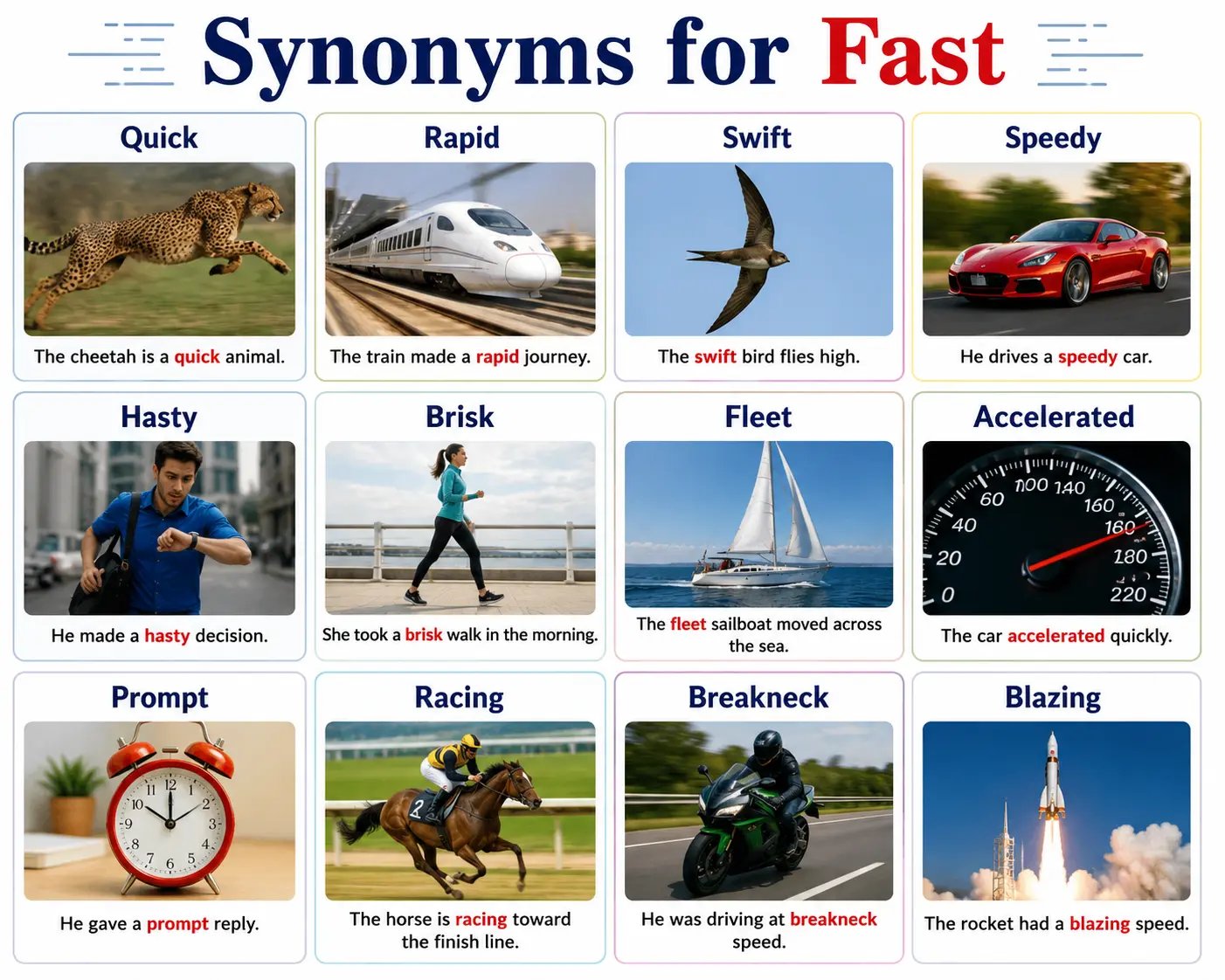
1. Quick (Adjective)
Meaning: Done in a short time.
Examples:
- She gave a quick answer.
- We took a quick break.
2. Rapid (Adjective)
Meaning: Happening very quickly.
Examples:
- Rapid growth surprised everyone.
- The river has rapid currents.
3. Swift (Adjective)
Meaning: Moving smoothly and quickly.
Examples:
- The bird made a swift turn.
- Help arrived swiftly.
4. Speedy (Adjective)
Meaning: Done without delay.
Examples:
- We need a speedy reply.
- Recovery was speedy.
5. Prompt (Adjective)
Meaning: Done at the right time without delay.
Examples:
- She gave a prompt response.
- Prompt action saved time.
6. Instant (Adjective)
Meaning: Happening immediately.
Examples:
- We received instant feedback.
- The coffee is instant.
7. Immediate (Adjective)
Meaning: Happening at once.
Examples:
- Immediate action is necessary.
- He needs immediate help.
8. Brisk (Adjective)
Meaning: Active and energetic.
Examples:
- We enjoyed a brisk walk.
- Business was brisk today.
9. Hasty (Adjective)
Meaning: Done too quickly.
Examples:
- It was a hasty decision.
- Don’t make hasty choices.
10. Hurried (Adjective)
Meaning: Done in a rush.
Examples:
- She ate a hurried lunch.
- His speech sounded hurried.
11. Fleet (Adjective)
Meaning: Very fast in movement.
Examples:
- The deer was fleet.
- Fleet horses won the race.
12. Nimble (Adjective)
Meaning: Quick and light in movement.
Examples:
- Cats are nimble animals.
- She has nimble fingers.
13. Agile (Adjective)
Meaning: Able to move quickly and easily.
Examples:
- The gymnast is agile.
- Agile workers adapt fast.
14. Lively (Adjective)
Meaning: Full of energy.
Examples:
- The children were lively.
- The party became lively.
15. Expeditious (Adjective)
Meaning: Done efficiently and quickly.
Examples:
- They handled the case expeditiously.
- We need expeditious service.
16. Breakneck (Adjective)
Meaning: Extremely fast.
Examples:
- They drove at breakneck speed.
- Change happened at breakneck pace.
17. Lightning-fast (Adjective)
Meaning: Extremely quick.
Examples:
- His reaction was lightning-fast.
- The internet is lightning-fast.
18. High-speed (Adjective)
Meaning: Operating at great speed.
Examples:
- We rode a high-speed train.
- High-speed internet helps work.
19. Turbocharged (Adjective)
Meaning: Made much faster.
Examples:
- The engine feels turbocharged.
- Sales became turbocharged.
20. Accelerated (Adjective)
Meaning: Happening faster than normal.
Examples:
- The project followed an accelerated schedule.
- Learning became accelerated.
21. Promptly (Adverb)
Meaning: Without delay.
Examples:
- She replied promptly.
- Please arrive promptly.
22. Swiftly (Adverb)
Meaning: In a very quick way.
Examples:
- Birds flew swiftly.
- He acted swiftly.
23. Rapidly (Adverb)
Meaning: At a high speed.
Examples:
- Technology changes rapidly.
- Prices increased rapidly.
24. Readily (Adverb)
Meaning: Quickly and willingly.
Examples:
- She readily agreed.
- Help was readily available.
25. Instantaneous (Adjective)
Meaning: Happening with no delay.
Examples:
- The response was instantaneous.
- The light turned on instantaneously.
26. Snappy (Adjective)
Meaning: Quick and lively.
Examples:
- She gave a snappy reply.
- The app feels snappy.
27. Whirlwind (Adjective)
Meaning: Extremely busy and fast.
Examples:
- It was a whirlwind tour.
- We had a whirlwind week.
28. Efficient (Adjective)
Meaning: Working quickly with little waste.
Examples:
- She is an efficient worker.
- The system is efficient.
29. Dynamic (Adjective)
Meaning: Full of energy and movement.
Examples:
- He is a dynamic leader.
- The market is dynamic.
30. Energetic (Adjective)
Meaning: Full of strength and activity.
Examples:
- The children are energetic.
- She gave an energetic performance.
Prototype Meaning
The most common meaning of fast is moving or happening quickly. Most people imagine a fast car, a fast runner, or a fast computer. The word usually describes high speed, quick action, or short waiting time.
check out our list ofhttps://prayermove.com/synonyms-for-great-list/
Prototype Categorization
- General Speed: Quick, Rapid, Swift, Speedy, Fleet, High-speed, Lightning-fast.
- Immediate Action: Prompt, Immediate, Instant, Instantaneous, Promptly.
- Movement and Flexibility: Nimble, Agile, Brisk, Lively.
- Extreme Speed: Breakneck, Turbocharged, Accelerated, Whirlwind.
- Efficient Performance: Efficient, Expeditious, Readily.
- Fast Action (Adverbs): Swiftly, Rapidly.
- Energy and Activity: Dynamic, Energetic, Snappy.
- Rushed Actions: Hasty, Hurried.
These categories help writers choose the most suitable synonym depending on whether they want to describe movement, time, efficiency, energy, or urgency.
Antonyms of Fast
Slow (Adjective)
Moving at a low speed.
Sluggish (Adjective)
Moving lazily or slowly.
Leisurely (Adjective)
Done without hurry.
Delayed (Adjective)
Happening later than expected.
Gradual (Adjective)
Happening little by little.
Unhurried (Adjective)
Done calmly without rushing.
Lazy (Adjective)
Not active or energetic.
Late (Adjective)
Occurring after the expected time.
Short Questions and Answers
What does fast mean?
It means moving, happening, or working quickly.
When should fast be used?
Use fast when describing speed, quick action, or something completed in a short time.
Is fast positive or negative?
It can be positive, negative, or neutral depending on the context. Fast service is positive, but a fast and careless decision can be negative.
How is it different from similar words?
Fast is a general word. Swift often sounds smooth, rapid is more formal, speedy emphasizes quick completion, and hasty suggests acting too quickly.
Conclusion
Learning synonyms for fast helps you express ideas with greater accuracy and variety. Instead of repeating the same word, you can choose alternatives that better match the situation, whether you are describing movement, quick decisions, rapid growth, or efficient work. A stronger vocabulary also improves speaking, writing, reading, and listening skills. It makes essays, emails, conversations, and creative writing more engaging and natural. As you practice these synonyms, you will become more confident in choosing the right word for every context. Make vocabulary learning a daily habit by reading, writing, and using new words in real-life sentences. Small daily practice leads to lasting improvement in English fluency.